
Ombre brows have become one of the most popular forms of permanent makeup in the last decade. With their soft gradient effect, lighter at the front, darker at the tail- they’re designed to look more polished and “filled in” than traditional microblading. For many patients, they deliver exactly that: a low-maintenance brow that looks defined every day without makeup.
But as PMU trends evolve, so do aesthetic preferences. And increasingly, patients are looking for ombre brow removal or correction- whether due to color shifting, over-saturation, shape changes, or simply wanting a softer, more natural look again. At CLEO, we’re seeing more patients than ever seeking laser-based correction of permanent makeup. And ombre brows, in particular, require a different level of understanding compared to other PMU styles. Here’s why:
What Makes Ombre Brows Different From Microblading
Not all permanent makeup behaves the same under the skin. Ombre brows (also called powder brows) are created using a machine that implants pigment more diffusely into the skin compared to microblading strokes.
That means:
- less “hair-like” structure
- more pixelated shading
- deeper or more uniform pigment distribution
- often higher saturation in certain areas
While this creates a soft makeup-like finish initially, it also means the pigment can behave differently over time.
Common long-term changes include:
- Ashy or gray fading
- Blue or reddish undertones
- Overly dense or blocky appearance
- Loss of gradient softness
- Shape drifting or heaviness in the tail
And because the pigment is often more densely placed, correction can be more complex than people expect.
Why Ombre Brows Don’t “Fade Away” Naturally
A common misconception is that permanent makeup will simply fade evenly over time.
In reality, pigment is implanted into the dermis — meaning it sits below the skin’s natural exfoliation cycle.
With ombre brows specifically, the density of pigment makes fading even more unpredictable:
- darker areas often persist longer
- lighter areas may shift color instead of disappearing
- uneven breakdown can distort the original shape
This is why many patients don’t end up with “faded brows,” but instead with muted or discolored versions of the original design.
Why Laser Is the Most Effective Removal Method
Laser removal works fundamentally differently than fading or surface-based correction methods.
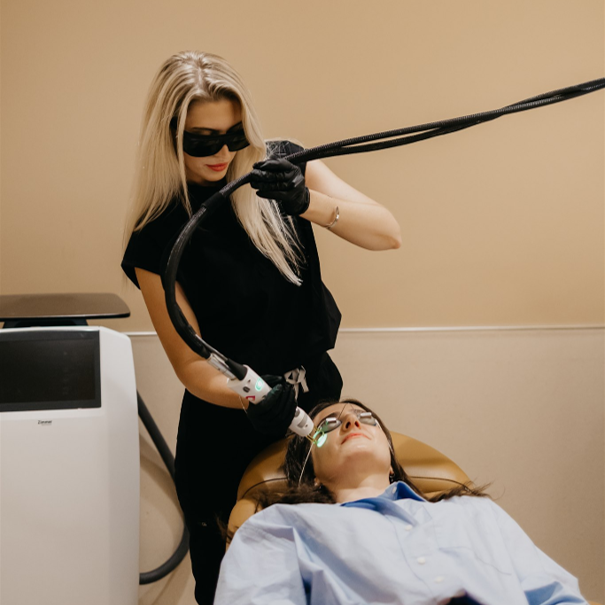
Instead of trying to exfoliate or lift pigment from the surface, laser systems deliver controlled energy that targets pigment particles beneath the skin, breaking them into smaller fragments.
Over time, the body naturally clears these particles through lymphatic processes.
This approach is particularly important for ombre brows because:
- pigment is often deeper and more evenly distributed
- color correction requires targeting multiple ink tones
- shape correction depends on gradual density reduction
Laser allows providers to adjust treatment based on:
- pigment depth
- saturation levels
- color shifts (black, brown, red, blue tones)
- skin type and sensitivity
That level of control is critical when working around the delicate brow area.
How Ombre Brow Removal Differs From Microblading Removal
While both are forms of PMU removal, they behave differently under laser treatment.
Microblading
- pigment is deposited in fine hair-like strokes
- often shallower placement
- tends to fade in a more fragmented pattern
- removal may reveal patchy remnants of strokes over time
Ombre / Powder Brows
- pigment is more densely packed
- often deeper and more uniform
- can appear darker or more stable in early sessions
- requires more gradual layering of removal
In short:
Microblading is about breaking up structure
Ombre brows are about reducing density and saturation
That distinction matters when designing a treatment plan.
The Reality: Brow Removal Is a Precision Process
One of the biggest misconceptions about ombre brow removal is that it’s a quick fix.
In reality, it is a staged process that often involves:
- gradual lightening over multiple sessions
- careful monitoring of color shifts
- preservation of natural brow hair and skin integrity
- potential planning for future brow redesign
In some cases, full removal is the goal. In others, partial fading is used to:
- soften overly dark brows
- correct asymmetry
- prepare for a new PMU style
- restore a more natural aesthetic baseline
The strategy matters as much as the technology.
The CLEO Perspective: Correction Over Erasure
At CLEO, ombre brow removal is not about aggressively erasing pigment at all costs. It’s about controlled correction- restoring balance, symmetry, and softness to the face while protecting the integrity of the skin. For some patients, that means full removal. For others, it means strategic fading to reset the canvas for a better-designed brow in the future. Because permanent makeup doesn’t have to be truly permanent anymore. It just has to be adjustable. Book a consultation with a CLEO energy-device expert today at one of our clinics in Minneapolis, Atlanta, St. Louis, or Detroit and let’s design your high-tech, clinically proven skin blueprint.

Leave a comment
This site is protected by hCaptcha and the hCaptcha Privacy Policy and Terms of Service apply.