
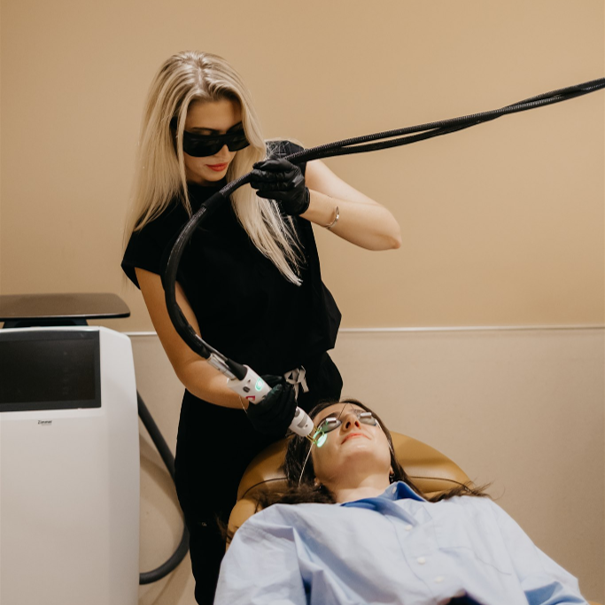
For many patients, laser hair removal is about convenience — smoother skin, less shaving, and long-term reduction in maintenance. But for patients with PCOS (Polycystic Ovary Syndrome), unwanted hair growth is not just cosmetic. It’s hormonal, persistent, and often more resistant to standard laser protocols. That’s why treating PCOS-related hair growth isn’t just “laser hair removal.” It’s a different clinical strategy altogether. At CLEO, we see a significant number of patients managing hormonal hair growth, and we approach these cases differently than traditional laser hair reduction protocols — including modified treatment timing as frequently as every 2 weeks in select cases, compared to the standard 4–6 week spacing.
Here’s why that matters:
Why PCOS-Related Hair Growth Is Different
PCOS-related hirsutism (excess facial and body hair growth) is driven by hormonal signaling, particularly increased androgen sensitivity at the follicle level.
This means:
- hair grows more persistently
- follicles may cycle more actively
- regrowth can appear faster between sessions
- multiple areas of the body are often affected simultaneously
Unlike typical cosmetic hair removal patients, PCOS patients are not dealing with a static hair cycle, they are dealing with a continuously hormonally stimulated system. That changes how laser needs to be timed and structured.
How Standard Laser Hair Removal Protocols Work
In most patients, laser hair removal is spaced every 4–6 weeks (or longer depending on body area) because the treatment is designed to target hair during the anagen (active growth) phase.
Hair grows in cycles:
- anagen (growth phase)
- catagen (transition phase)
- telogen (resting phase)
Traditional spacing works because follicles gradually synchronize into treatable phases over time. But with PCOS, that synchronization is often disrupted.
Why PCOS Requires a More Frequent Strategy
In hormonal hair growth, new follicles can be recruited into active growth more continuously.
That’s why in many PCOS cases, spacing treatments too far apart can allow:
- new terminal hairs to develop between sessions
- visible regrowth before the next cycle is treated
- slower overall reduction in density
At CLEO, we often adjust protocols based on clinical response, and in select PCOS patients, that can include shorter interval treatments — sometimes as frequent as every 2 weeks in targeted areas. The goal is not simply routine scheduling — it’s maintaining consistent follicle targeting during active hormonal stimulation cycles.
This can help:
- reduce visible regrowth between sessions
- improve cumulative follicle reduction
- maintain momentum in treatment response
- optimize outcomes in hormonally driven hair growth patterns
Treatment Is Not One-Size-Fits-All
It’s important to understand that PCOS laser hair removal is highly individualized.
Factors that influence treatment planning include:
- hormonal activity level
- hair thickness and density
- treatment area (face vs body vs combination)
- skin type and sensitivity
- response to prior laser sessions
- concurrent medical management (if any)
This is why a standardized “one schedule fits all” approach often underperforms in hormonal cases.
Instead, protocols are adjusted dynamically based on how the skin and hair follicles respond over time.
What Patients Often Notice First
With consistent treatment, PCOS patients typically observe:
- slower regrowth speed
- finer hair texture over time
- reduced density in treated zones
- less frequent need for shaving or waxing
- improved skin smoothness and reduced irritation
However, results are gradual and cumulative — especially because hormonal signaling can continue to activate new follicles over time.
This is why consistency and correct timing matter as much as the laser itself.
Why Timing Matters as Much as Technology
Laser hair removal is not just about energy delivery it’s about timing that energy to follicle biology. In PCOS patients, where follicles may cycle more actively or unpredictably, spacing sessions too far apart can reduce efficiency. More frequent, targeted sessions in some cases can help maintain better overlap with active growth cycles, improving overall long-term reduction. This is where clinical adjustment rather than rigid scheduling becomes critical.
The CLEO Approach: Personalized, Not Protocol-Based
At CLEO, we don’t treat PCOS-related hair growth as a standard laser hair removal case. We treat it as a hormonal pattern requiring adaptive strategy. For some patients, that means traditional 4–6 week spacing. For others, especially in early phases of treatment or high-activity areas, it may mean more frequent sessions, sometimes as close as every 2 weeks, depending on response and clinical judgment. The goal is always the same: reduce density, slow regrowth, and restore long-term control over unwanted hair growth. Because with PCOS, consistency matters — but so does precision in timing.

Leave a comment
This site is protected by hCaptcha and the hCaptcha Privacy Policy and Terms of Service apply.